
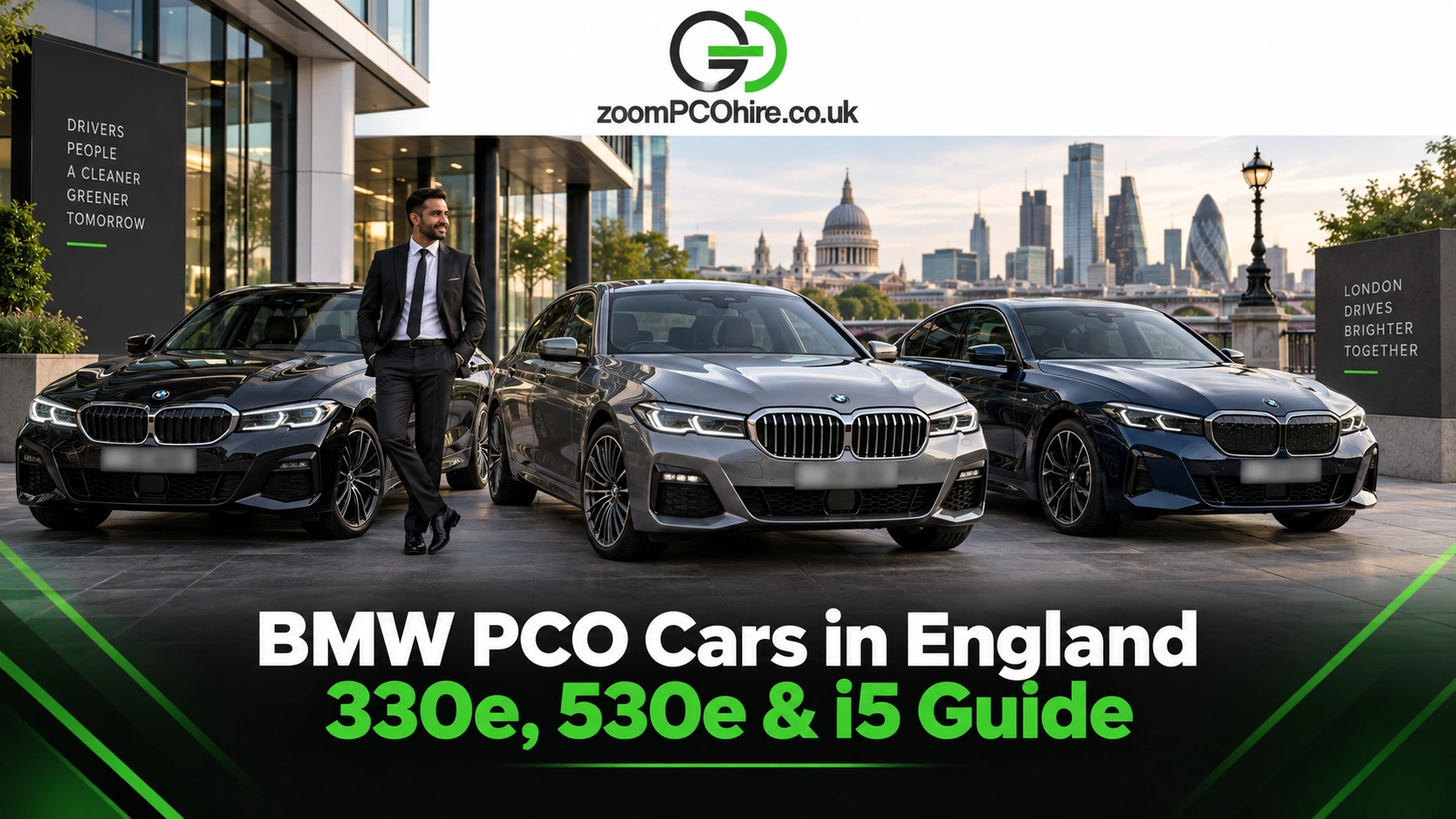
Choosing a BMW for private hire is not simply about picking the most expensive model. The 330e, 530e and i5 suit three different types of PCO driver.
The BMW 330e works well for drivers who want plug-in hybrid flexibility in a more manageable saloon. The BMW 530e adds more executive space and comfort for airport and business passengers. The BMW i5 moves fully electric and makes more sense for drivers who already have reliable charging and want a premium EV for executive work.
The right choice comes down to your daily mileage, charging access, passenger type and weekly vehicle cost. If you are comparing BMW with other makes, our guide to the best PCO cars by brand across England explains where BMW fits alongside Tesla, Mercedes, MG, Kia and MAXUS.
Important: Vehicle specifications and Uber/Bolt eligibility can change by model year, city and platform category. Always check the exact car, PHV licence requirements and current driver-app eligibility before committing.
Which BMW Is Best for PCO Drivers?
Choose the BMW 330e if you want a smaller plug-in hybrid for mixed city and motorway work, with petrol available when charging is inconvenient.
Choose the BMW 530e if executive passengers, airport journeys and extra cabin comfort matter more, but you still want plug-in hybrid flexibility.
Choose the BMW i5 if you want a fully electric executive saloon and already have a dependable charging routine.
BMW 330e suits:
- mixed city and motorway work
- drivers who want petrol backup
- Comfort-style private hire where eligible
- regular charging without full EV dependence
- drivers who prefer a more manageable executive saloon
BMW 530e suits:
- business passengers
- airport journeys
- executive private hire
- longer shifts
- drivers who want more comfort without going fully electric
BMW i5 suits:
- fully electric private hire
- executive and corporate passengers
- premium airport work
- high-mileage drivers with reliable charging
- drivers moving away from petrol completely
BMW 330e vs 530e vs i5 at a Glance
| Factor | BMW 330e | BMW 530e | BMW i5 |
|---|---|---|---|
| Powertrain | Plug-in hybrid | Plug-in hybrid | Fully electric |
| Best for | Mixed city and motorway work | Executive and airport work | Premium electric PHV work |
| Passenger feel | Premium compact saloon | Roomier executive saloon | Modern electric executive saloon |
| Charging dependence | Low to medium | Low to medium | High |
| Petrol backup | Yes | Yes | No |
| Airport suitability | Good | Very good | Very good |
| Best driver type | Flexible PHEV driver | Executive PHEV driver | Charging-ready EV driver |
BMW’s current UK model pages quote up to 63 miles WLTP electric range for current 330e and 530e versions. The current BMW i5 eDrive40 M Sport is listed at up to 356 miles WLTP. These figures relate to current BMW models and should not be assumed to apply to older used vehicles in the Zoom fleet; actual range also varies with weather, load, charge level and driving style.
Driver Decision Checklist
Use this before looking at specifications in detail.
| Question | BMW to consider |
|---|---|
| Do you want petrol backup? | 330e or 530e |
| Is most of your work city-based? | 330e |
| Do you regularly carry business or airport passengers? | 530e or i5 |
| Do you want to move fully electric? | i5 |
| Is charging access unreliable? | 330e or 530e |
| Is executive passenger comfort a major part of your service? | 530e or i5 |
| Are you still testing premium PCO work? | Consider PCO car hire before a long-term commitment |
BMW 330e: Best for Flexible Mixed PCO Work
The BMW 330e makes the most sense for drivers who want the benefits of electric driving without depending entirely on charging.
It combines a petrol engine with a rechargeable battery. That allows shorter journeys to be completed electrically when the battery is charged, while the petrol engine provides backup for motorway runs, unexpected bookings or longer shifts.
BMW’s current 330e M Sport Saloon offers up to 63 miles of WLTP electric range and supports AC charging at up to 11 kW. BMW notes that real-world results depend on factors such as battery charge, weather, driving style and vehicle load.
Why the 330e can work for PCO drivers
It is a strong choice for:
- urban private hire
- city and motorway mixed shifts
- occasional airport work
- business passengers
- drivers who can charge regularly but want petrol backup
Its smaller footprint also makes it easier to manage than a larger 5 Series around tighter streets, hotel entrances and busy pickup areas.
Zoom currently offers a BMW 330e SE Auto for PCO car hire. The available vehicle is an earlier model than BMW’s current-generation 330e, so its specifications and electric range differ from the latest BMW figures.
The main 330e watch-out
A plug-in hybrid only works properly as a cost-saving tool if you actually plug it in.
If the battery is rarely charged, you carry the extra weight of the hybrid system while relying much more heavily on petrol. Drivers deciding between a plug-in hybrid and a full EV should read our PHEV vs EV guide for PCO drivers.
BMW 530e: Best for Executive PHEV Work
The BMW 530e takes the PHEV idea into a larger executive saloon.
It is better suited to drivers who regularly carry business passengers, do airport work or want more cabin comfort than the 330e without becoming completely dependent on EV charging.
BMW currently lists the 530e M Sport Saloon with up to 63 miles of WLTP electric range. As with all PHEVs, actual electric range depends on charge level, weather, driving conditions and vehicle load.
Where the 530e makes more sense
It can be a better choice for:
- corporate passengers
- hotel pickups
- airport saloon trips
- longer motorway journeys
- executive private hire
- drivers who need petrol backup
The extra size and more executive feel can be useful if passenger experience is part of what you are selling.
Zoom’s available BMW 530e M Sport PCO car is an earlier model with different battery and range specifications from the current BMW 530e, so use the vehicle page when comparing the exact car available for hire.
When the 530e may be unnecessary
If most of your work is short city trips with one passenger, the extra size and weekly cost may not bring enough benefit over the 330e.
The 530e makes more sense when you can actually use its executive positioning.
BMW i5: Best for Fully Electric Executive PCO Work
The BMW i5 is the clear choice from these three if you want to move fully electric.
Unlike the 330e and 530e, there is no petrol engine. Your entire working day depends on battery range, charger access and how well you plan charging around your shifts.
BMW currently lists the i5 eDrive40 M Sport Saloon with up to 356 miles WLTP range. BMW also makes clear that real-world results can change with weather, accessories, vehicle load and driving style.
Why the i5 suits executive PHV work
It offers:
- quiet electric driving
- executive 5 Series passenger space
- modern premium cabin
- good motorway suitability
- no petrol use
- strong fit for corporate and airport passengers
Drivers considering the model can view Zoom’s BMW i5 M Sport Edition rent-to-buy option.
The i5 makes most sense when
- you already understand EV charging
- charging is available near home, work or regular routes
- you do enough premium work to support the vehicle cost
- long airport or motorway journeys are planned around battery level
- you want a long-term electric setup
If you are also considering Mercedes, our Mercedes EQE vs BMW i5 comparison looks specifically at those two executive EVs.
Which BMW Is Better for City PCO Work?
For mainly city-based work, the BMW 330e is the easiest of the three to justify.
Its smaller size works well for:
- busy pickup points
- narrow roads
- stop-start traffic
- local business journeys
- mixed short and medium trips
If you keep the battery charged, much of your shorter driving can use electric power while petrol remains available when your shift changes.
The 530e can still work well in cities, but its advantages become more valuable when executive passengers and airport jobs are part of the week.
The i5 works well in urban driving too, but choosing it only makes sense when charging fits your routine.
Your vehicle also needs to match when you work. The PCO Driver Peak Hours Guide explains how airport, commuter and weekend demand differ across a working week.
Which BMW Is Better for Airport Runs?
For occasional airport work, the 330e can be enough. For regular executive airport jobs, the 530e and i5 are stronger choices.
BMW 330e
Works well for:
- solo travellers
- couples
- lighter luggage
- drivers mixing airport and city work
BMW 530e
Better suited to:
- business travellers
- executive transfers
- longer airport routes
- passengers who value extra saloon comfort
- drivers who want petrol backup for unpredictable mileage
BMW i5
Strong for:
- corporate airport travel
- premium EV service
- longer electric journeys
- drivers who can charge around airport work
Airport profitability is not decided by the car alone. Waiting charges, parking, luggage and empty return journeys can change the value of the trip. Our airport runs guide for PCO drivers covers those issues in detail.
PHEV or EV: Which BMW Powertrain Makes More Sense?
This is probably the biggest difference between the three cars.
Choose the 330e or 530e if:
- your charging access is inconsistent
- your shifts change at short notice
- motorway work is common
- you want petrol backup
- you are not ready to depend fully on public charging
Choose the i5 if:
- charging is reliable
- your routes are reasonably predictable
- you want to stop buying petrol
- you can charge outside your strongest earning hours
- you are comfortable planning longer EV journeys
A PHEV should not be treated like an ordinary petrol car. BMW’s current 330e and 530e are designed to be charged from the mains, and regular charging is what allows drivers to make meaningful use of their electric-only range.
Which BMW Is Better for Executive Passengers?
The 330e, 530e and i5 can all offer a premium passenger experience, but they sit at different levels.
BMW 330e
A good fit for:
- standard premium private hire
- business passengers
- Comfort-style work where eligible
- drivers who want a compact executive saloon
BMW 530e
Better when:
- passenger space matters more
- airport and hotel trips are common
- you want traditional executive saloon positioning
- longer journeys form a larger part of your week
BMW i5
Best suited to:
- premium EV positioning
- corporate passengers
- executive airport work
- drivers selling a modern electric experience
For drivers targeting higher platform categories, the Uber Comfort, Exec & XL guide explains how each category differs and what to check before upgrading.
BMW Cars for Uber, Bolt and PHV Work
A BMW badge does not automatically make a vehicle eligible for Comfort, Exec or Premium work.
Uber’s current UK baseline requirements include an accepted PHVL, private hire insurance, four doors, good condition, no commercial branding and licensing for at least four passengers. Its Exec rules also include brand, colour, vehicle-age and driver-performance requirements, and Uber says its accepted-vehicle rules can change.
Uber announced further Comfort, Exec and Lux vehicle-eligibility changes in July 2026. The new requirements apply to newly added vehicles from 1 August 2026 in London and from 19 October 2026 in the rest of the UK, so checking the latest accepted list is especially important before choosing a BMW for a premium category.
Bolt’s UK Comfort category currently requires, among other things, four doors, at least four passenger seats excluding the driver, correct local licensing, good condition and qualifying vehicle age. Availability and accepted models vary by location.
Which BMW Works Best Without Home Charging?
For drivers with poor charging access, 330e or 530e offers more flexibility than the i5.
BMW 330e
Petrol backup means a missed charge does not stop your shift. Regular charging is still important if you want the PHEV to make sense.
BMW 530e
The same principle applies, but the larger car needs enough executive work to justify its overall cost.
BMW i5
The i5 can work without home charging, but only when you have dependable public, workplace or destination chargers that fit your routes.
If public charging regularly forces you offline during busy periods, the convenience of a PHEV may matter more than the benefits of going fully electric.
For a detailed cost comparison, see EV Charging Costs for PCO Drivers.
Running Costs: Look Beyond Petrol and Electricity
Do not choose between 330e, 530e and i5 using fuel or electricity cost alone.
Your weekly calculation should include:
- vehicle payment
- private hire insurance
- petrol
- electricity
- public rapid charging
- tyre wear
- servicing
- charging downtime
- parking and airport fees
- dead miles
The cheapest car per mile can still be the wrong business choice if it limits the jobs you want. The most premium BMW can also reduce take-home if its weekly cost is not supported by better-value work.
A 330e that is never charged can lose much of its PHEV advantage. A 530e needs enough executive use to justify the step up. An i5 can benefit from lower dependence on petrol, but expensive public charging and downtime can reduce that advantage.
BMW PCO Car Hire vs Rent-to-Buy
The right agreement depends on how certain you are about the car and your work pattern.
PCO car hire can make more sense if:
- you are trying BMW for the first time
- you want to compare 330e and 530e
- executive demand is not yet proven
- you are still learning your weekly mileage
- you want flexibility before committing
Drivers can compare current options on the PCO car hire page.
Rent-to-buy can make more sense if:
- you work full-time
- weekly earnings are stable
- you already know which vehicle fits your work
- your charging routine is established
- you want a longer-term plan
For long-term options, see rent-to-buy PCO cars.
The agreement should follow the work pattern, not the other way around.
BMW PCO Driver Fit Table
| Driver type | BMW to consider | Why |
|---|---|---|
| Mainly city and mixed private hire | BMW 330e | Smaller PHEV with petrol backup |
| Executive and airport PHEV work | BMW 530e | More passenger comfort with hybrid flexibility |
| Premium fully electric work | BMW i5 | Executive EV with no petrol engine |
| Weak charging access | BMW 330e or 530e | Petrol backup provides more flexibility |
| Reliable charging and premium passengers | BMW i5 | Fully electric executive option |
| XL or large group work | None of these | A 7-seater or MPV is more suitable |
How Zoom PCO Hire Helps Drivers Choose a BMW
Choosing between the BMW 330e, 530e and i5 should start with the work you actually do.
Zoom PCO Hire can help drivers compare available BMW options based on weekly mileage, airport work, passenger type, charging access and budget. Drivers who are still testing a car or work pattern can start with flexible PCO car hire, while those with stable full-time work can compare longer-term rent-to-buy options.
The aim is to choose a BMW that supports your earnings rather than simply increasing your weekly costs.
Final Thoughts
There is no single BMW that suits every PCO driver.
330e for flexible mixed work and petrol backup. Choose the 530e when executive comfort and airport journeys matter more but you still want PHEV flexibility. Choose the i5 when you are ready for a fully electric executive saloon and have reliable charging.
The right BMW is the one that fits your real shifts, passengers and weekly budget.
Frequently Asked Questions
Which BMW is best for PCO drivers?
It depends on your work. The BMW 330e suits mixed city and motorway driving, the 530e suits executive and airport PHEV work, and the i5 suits drivers ready for a fully electric premium saloon.
Is the BMW 330e good for PCO work?
Yes. The 330e can work well for drivers who mix city trips with motorway journeys and want petrol backup. It makes most sense when the battery is charged regularly rather than being driven mainly on petrol.
Is the BMW 530e good for private hire?
Yes. The 530e can suit airport, business and executive private hire work. It provides more cabin space than the 330e while keeping plug-in hybrid flexibility.
Is the BMW i5 good for PCO drivers?
The i5 can be a strong option for executive EV work, corporate passengers and airport journeys. It suits drivers who have reliable charging and can manage a fully electric car around their shifts.
Which BMW is better for airport work: 330e, 530e or i5?
The 330e is suitable for occasional airport jobs and lighter passenger needs. The 530e and i5 make more sense when executive airport work is a regular part of your week.
Which BMW is better without home charging?
The 330e and 530e offer more flexibility because they have petrol backup. The i5 can still work, but you need dependable public or workplace charging that does not regularly interrupt earning hours.
Can BMW cars be used for Uber Comfort or Exec?
Some BMW models may be accepted, but eligibility depends on the exact vehicle, model year, colour, city, PHV licence and current platform rules. Check Uber or Bolt’s current accepted vehicle requirements before committing.
Should I hire or rent-to-buy a BMW PCO car?
PCO hire is useful when you are testing the vehicle, your routes or executive demand. Rent-to-buy is better considered once your weekly earnings, mileage and charging routine are stable.
