
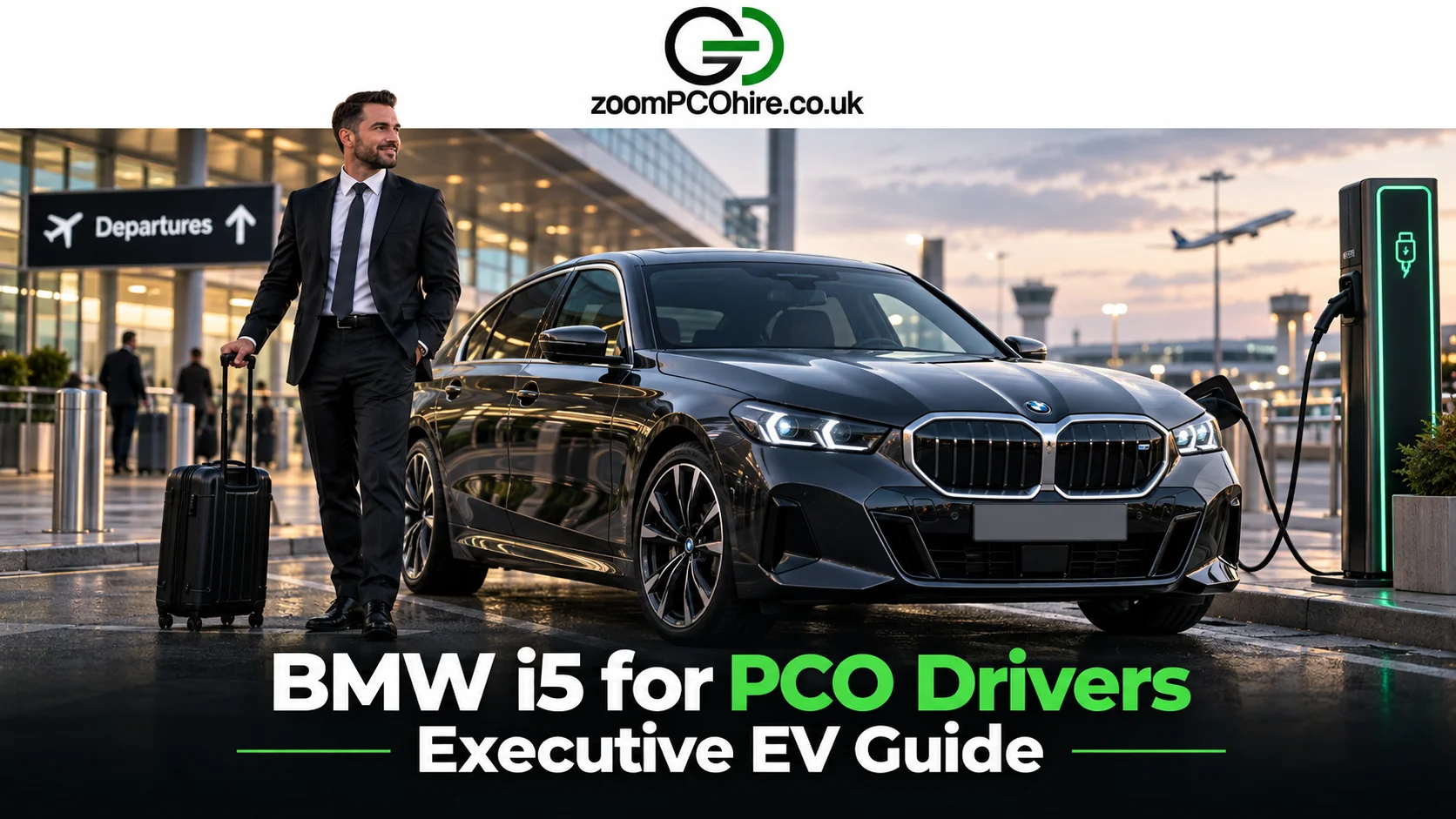
A BMW i5 only makes sense for a PCO driver when the charging routine, passenger demand and weekly cost all support an executive electric car.
It gives you the comfort and road presence of a BMW 5 Series without a petrol engine, making it attractive for business passengers, hotel pickups, airport journeys and longer premium private hire work. But unlike a plug-in hybrid, there is no petrol backup when the battery gets low.
That means choosing an i5 is less about whether EVs are good and more about whether your own working pattern fits this particular EV.
Drivers still deciding between BMW powertrains can compare the wider range in our BMW PCO cars across England guide.
Important: Range, charging speed and platform eligibility can vary by vehicle specification, model year and city. Always check the exact BMW i5 you are considering and the latest private hire requirements before committing.
Is the BMW i5 Good for PCO Drivers?
Yes. The BMW i5 can be a strong PCO car for drivers who regularly carry business, executive and airport passengers and already have reliable charging available around their working routine.
It makes most sense if:
- you want a fully electric executive saloon
- airport and business journeys are common
- you can charge without regularly losing earning time
- your weekly mileage makes EV running worthwhile
- your passenger demand supports a premium vehicle
- you mainly carry normal saloon-size bookings
Think carefully before choosing it if you rely completely on expensive rapid charging, frequently need XL capacity or have no reliable charging backup.
BMW i5 PCO Driver Snapshot
| Factor | BMW i5 | PCO driver takeaway |
|---|---|---|
| Powertrain | Fully electric | No petrol backup, so charging needs planning |
| Vehicle type | Executive electric saloon | Best suited to premium private hire work |
| Best work type | Business, executive and airport journeys | Passenger type should justify the car |
| Seats | 5 | Normal saloon work rather than XL |
| Boot | 490 litres on the current model | Useful for normal airport bookings |
| Main requirement | Reliable charging | Charging downtime should not regularly interrupt earnings |
BMW currently lists the i5 eDrive40 M Sport Saloon with up to 356 miles WLTP, 340 hp and up to 205 kW DC charging. BMW also explains that real-world range can change with starting charge, weather, accessories, driving style and vehicle load.
Our current BMW i5 Sport Edition listing shows its own vehicle specification, including a stated 347-mile range, five seats and a 490-litre boot. Use the vehicle listing when assessing the exact car available rather than assuming every i5 has identical figures.
Why the BMW i5 Fits Executive Private Hire Work
The strongest reason to choose an i5 is not simply that it is electric. It is the combination of executive passenger comfort and electric driving.
That can work well for:
- corporate passengers
- hotel pickups
- business meetings
- executive airport transfers
- longer motorway journeys
- passengers who expect a premium saloon
Electric driving also suits this type of service because the journey is quiet and smooth, especially during urban pickups and lower-speed travel.
But the i5 only becomes easier to justify when the passenger experience forms part of what you are selling. If most of your work would pay exactly the same regardless of whether you arrive in a premium BMW, the higher vehicle commitment deserves closer attention.
Is the BMW i5 Good for Airport Work?
Yes. The BMW i5 can be particularly well suited to executive airport work, provided your charging routine supports the mileage.
It works well for:
- solo business travellers
- couples
- hotel guests
- corporate airport bookings
- premium saloon journeys
- longer motorway transfers
The i5’s 490-litre luggage compartment also gives it useful capacity for normal saloon airport bookings.
However, a boot-size figure does not tell you whether a particular combination of suitcases will fit. If airport work forms a large part of your week, test the exact car with the type of luggage your passengers normally carry.
Keep a battery buffer
Airport work can change unexpectedly.
Flights are delayed. Return bookings appear. A passenger may need to travel farther than expected.
For that reason, an airport-focused EV driver should avoid arriving at every destination with the battery nearly empty. Keeping a sensible buffer gives you more freedom to accept the next booking without immediately searching for a charger.
BMW i5 Range: What Matters for a PCO Driver?
Official range is useful for comparing vehicles, but PCO drivers should plan around usable working range rather than expecting the WLTP figure every day.
For private hire work, range can be affected by:
- motorway speeds
- cold weather
- cabin heating
- air conditioning
- passenger and luggage weight
- repeated acceleration
- tyre condition
- how much battery you have at the start of the shift
This matters because a driver doing repeated motorway airport trips will use the car differently from somebody completing mostly urban journeys.
Do not plan your working day around the maximum figure
A stronger approach is to decide:
- how many miles you normally drive per shift
- how much reserve you want
- where you can recharge if the day changes
- whether winter conditions require a larger buffer
That tells you much more than simply asking whether the i5 can achieve its headline range.
Charging the BMW i5 Around PCO Work
Charging should fit around the shift rather than the shift constantly fitting around charging.
BMW states that the current i5 can charge at up to 205 kW DC, with a quoted 10–80% charging time of around 30 minutes under suitable conditions. An 11 kW AC wallbox takes considerably longer and is more suitable when the vehicle will already be parked.
Best setup: home or workplace charging
For a full-time driver, the easiest setup is usually being able to start the working period with a useful level of charge.
That allows you to:
- charge while sleeping or resting
- avoid unnecessary charger detours
- reduce reliance on expensive rapid charging
- protect strong earning hours
Can the BMW i5 work without a home charger?
Yes, but your public charging routine needs to be reliable.
You should know:
- your main charger
- at least one backup
- where to charge near your regular routes
- which chargers are usually available
- when charging will cause the least lost earning time
If public charging is your main option, our EV guide for PCO drivers without a home charger covers the wider planning issues in more detail.
Use rapid charging strategically
Rapid charging is valuable when you need a quick top-up, but relying on it every day can increase both charging cost and working downtime.
For current home-versus-public cost planning, see our EV Charging Costs for PCO Drivers guide.
Passenger Comfort, Luggage and Daily Practicality
The i5 is an executive saloon, but it is not a small car.
Its size helps create the passenger space expected from a modern 5 Series, which can be useful on longer journeys and business bookings. At the same time, drivers should consider how the car fits their regular working environment.
Think about:
- hotel entrances
- airport pickup areas
- narrow residential roads
- multistorey car parks
- roadside pickup points
- charging-bay dimensions
For passengers, the strongest setup is usually one to three people with normal luggage. That leaves a more comfortable rear cabin and keeps the boot practical.
For regular six- or seven-passenger work, the i5 is the wrong type of vehicle. A proper MPV or 7-seater should be used instead.
The goal is not to make one premium saloon handle every possible booking. It is to use it for the work it does well.
What Does a BMW i5 Cost to Run for PCO Work?
Do not judge the i5 only by how much electricity costs.
For a full-time PCO driver, your weekly figure can include:
- vehicle payment
- private hire insurance
- electricity
- public rapid charging
- tyres
- servicing
- cleaning
- airport fees
- parking
- dead mileage
- downtime
A simple energy calculation is:
Weekly charging cost = total kWh charged × average price paid per kWh
But the more important number is:
True weekly i5 cost = vehicle payment + insurance + charging + maintenance allowance + work-related fees
Charging location changes the economics
A driver who charges mainly at home or work can have a very different cost per mile from a driver who depends heavily on public rapid chargers.
The i5 is also a large premium EV, so tyre costs should not be ignored. High mileage, vehicle weight and driving style can all affect how often tyres need attention.
Most importantly, do not assume an EV automatically produces higher profit.
The vehicle still needs enough suitable work to justify its total weekly cost.
Use our PCO Driver Costs explained guide to calculate the rest of your weekly expenses rather than repeating the full cost framework here.
Does the BMW i5 Make Sense for High-Mileage PCO Work?
It can, but high mileage makes charging quality more important, not less.
The i5 can suit high-mileage work when:
- you start most shifts well charged
- your daily routes are reasonably predictable
- charging is available near your normal routine
- you have backup charging options
- motorway and airport mileage can be planned
- you avoid losing your strongest earning periods to chargers
It becomes more difficult when:
- daily mileage changes heavily without warning
- public chargers near your routes are unreliable
- you repeatedly arrive at low battery levels
- rapid charging becomes your default every day
A driver covering many miles can benefit significantly from a well-planned EV setup, but poor charging planning can quickly turn range and downtime into daily problems.
BMW i5 for Uber, Bolt and PHV Work
The BMW i5 may suit Uber, Bolt and other private hire work, but eligibility depends on the exact vehicle, model year, city and current platform rules.
Uber and Bolt require the correct PHV licence, insurance and an eligible vehicle. Higher categories such as Comfort, Exec or Premium have additional requirements, so always check the latest Uber UK requirements and Bolt Premium requirements before choosing the car.
For category differences, see our Uber Comfort, Exec & XL guide.
BMW i5 Maintenance, Tyres and Downtime
The i5 removes many petrol-engine service items, but it is not maintenance-free.
High-mileage drivers should still pay attention to:
- tyre pressure and tread
- brakes
- suspension
- warning lights
- cooling systems
- charging equipment
- cabin filters
- software or system alerts
- manufacturer service requirements
Tyres deserve particular attention on a large executive EV. Replacing them is not only a cost; a damaged tyre can also take the car off the road during an earning day.
That is why downtime should be treated as part of vehicle cost.
A simple daily, weekly and monthly routine is available in our PCO Driver Maintenance Checklist guide.
Who Should Choose a BMW i5 for PCO Work?
| BMW i5 makes sense if… | Consider another vehicle if… |
|---|---|
| You have reliable charging | Charging regularly interrupts your working day |
| You carry business and airport passengers | Most bookings are low-value short trips |
| You want a fully electric executive saloon | You want petrol backup for unpredictable mileage |
| Your mileage makes an EV setup worthwhile | You cannot make regular use of the EV advantages |
| Your earnings support a premium vehicle | The weekly commitment would reduce take-home too much |
| You mainly carry normal saloon bookings | You regularly need XL or group capacity |
The i5 is therefore strongest for drivers who already know what their work looks like. It is a less sensible choice when the charging plan and premium passenger demand are still uncertain.
Is Rent-to-Buy a Good Fit for a BMW i5?
Rent-to-buy can suit a full-time PCO driver who already knows that a premium EV fits their long-term work.
It may make sense if:
- you work full-time
- weekly earnings are stable
- charging access is already proven
- airport or executive work is regular
- you intend to remain with an EV for the long term
- the weekly commitment fits your real take-home
Think more carefully if you have never run a full EV for private hire or still depend on uncertain public charging.
Drivers comparing other long-term vehicles can also check PCO rent-to-buy options.
How Zoom PCO Hire Helps Drivers Choose an Executive EV
Choosing an i5 should start with your work rather than the badge or headline range.
Zoom PCO Hire specialises in PCO and PHV vehicles and can help drivers compare an executive EV against their weekly mileage, airport work, passenger requirements, charging access and long-term budget.
If those factors fit, the BMW i5 can be a strong long-term option. If they do not, choosing a different PCO vehicle can make better financial sense than forcing a premium EV into the wrong working pattern.
Final Thoughts
The BMW i5 can be a strong PCO car for drivers who regularly carry business and airport passengers, want a fully electric executive saloon and already have a dependable charging plan.
Its biggest strength is combining BMW 5 Series comfort with a fully electric drivetrain. Its biggest risk is committing to a premium EV before your charging access and passenger demand are ready for it.
If your mileage, charging routine and weekly budget all fit, Zoom PCO Hire can help you assess the available BMW i5 and long-term rent-to-buy options for private hire work across England.
Frequently Asked Questions
Is the BMW i5 good for PCO drivers?
Yes. The BMW i5 can suit PCO drivers who regularly complete business, executive and airport work and have reliable charging. It is less suitable when charging frequently interrupts earning time or the driver’s work does not justify a premium vehicle.
Is the BMW i5 good for Uber drivers?
It may be suitable for Uber and other private hire work, but category eligibility depends on the exact vehicle, city, registration year and current platform requirements. Always confirm eligibility before committing.
What is the BMW i5 electric range?
BMW currently quotes up to 356 miles WLTP for the i5 eDrive40 M Sport Saloon. Real-world range varies with charge level, weather, load, route and driving style.
How long does a BMW i5 take to charge?
BMW states that the current i5 eDrive40 can charge at up to 205 kW DC and can complete a 10–80% rapid charge in around 30 minutes under suitable conditions. An 11-kW AC wallbox takes around 8.5 hours.
Can I use a BMW i5 without a home charger?
Yes, but you need dependable public or workplace charging that fits around your shifts. If charging regularly creates long detours or interrupts peak earning periods, the i5 becomes harder to run efficiently.
Is the BMW i5 good for airport transfers?
Yes. The i5 is well suited to executive saloon airport bookings, particularly business travellers, couples and hotel guests. Drivers carrying large groups should use a larger MPV or 7-seater.
Can the BMW i5 qualify for Uber Exec?
Potentially, but eligibility depends on the exact vehicle, age, colour, city and current Uber requirements. Uber has updated its premium-category rules during 2026, so the exact vehicle should always be checked before commitment.
Is BMW i5 rent-to-buy suitable for PCO drivers?
It can suit full-time drivers who already have stable earnings, reliable charging and regular executive or airport work. Drivers who are still testing EV work should avoid making a long-term decision based only on the vehicle’s headline specification.
