
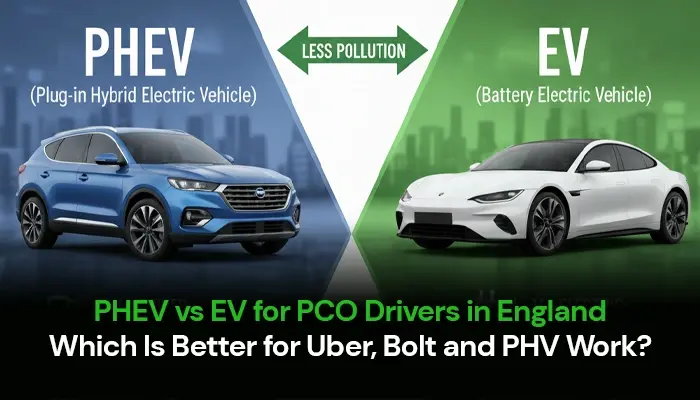
Thinking about upgrading your PCO car but not sure which way to go? You are not alone. Many PCO drivers in England are asking the same question right now: “Should I choose a plug-in hybrid (PHEV) or go fully electric (EV) for Uber, Bolt or PHV work?”
Both options can help you cut running costs and comply with ULEZ and Clean Air Zones, but they suit different types of drivers and shifts. Today, we will break down PHEVs and EVs in simple terms, compare their pros and cons for real private hire work, share example cars, and help you decide which one fits your daily routine.
What Is a PHEV and What Is an EV?
What is a PHEV?
A PHEV (plug-in hybrid) has:
- A petrol engine
- An electric motor and a battery that you can charge
- A short electric-only range, then petrol takes over for longer trips
If the battery is low, you can still drive on fuel. Common PCO driver choices often include Hyundai IONIQ PHEV and Mitsubishi Outlander PHEV.
What is an EV?
An EV (electric vehicle) has:
- No petrol or diesel engine
- Only an electric motor and a larger battery
- You must charge it to drive; there is no fuel backup
EVs are smooth, quiet and cheap to run per mile, especially if you can charge at home or work. Common PCO choices include Nissan, MG5 Trophy, and MG4.
PHEV for PCO Drivers: Pros and Cons
Many PCO and PHV drivers see PHEVs as a good “middle step” between petrol and full electric.
Benefits of PHEV
- Less range worries
If you cannot charge, you can still drive on petrol, which is handy for airport runs, late-night jobs or long-distance work.
- Lower fuel cost than pure petrol
When you charge regularly and use electric mode in town, you can cut fuel costs compared to a normal petrol car.
- Good for mixed driving
Works well if your day is a mix of city trips and motorway journeys, for example, between city centres and airports.
Downsides of PHEV
- You must actually plug in
If you rarely charge, you carry the weight of a battery but mostly burn petrol, which makes it less efficient. Real-world tests show PHEVs can pollute more than expected when drivers do not plug in often.
- More to maintain
You still have an engine and an electric system, so there are more parts than in a pure EV.
EV for PCO Drivers: Pros and Cons
EVs can be brilliant for busy city work, but they need a bit more planning.
Benefits of EV
- Very low energy cost per mile
Charging (especially at home or off-peak) is usually far cheaper than petrol or diesel, which helps protect your earnings.
- Smooth, quiet ride
Passengers often comment on how quiet and clean EVs feel, which can support good ratings and tips.
- Zero tailpipe emissions
EVs are ideal for ULEZ and Clean Air Zones and are increasingly encouraged for taxi and private hire work in England cities.
Downsides of EV
- Charging and planning
You must think about where and when you will charge, especially if you do high daily mileage or work late nights.
- Winter range drop
In cold weather, EV range can fall noticeably, so you need to allow extra buffer and plan short top-ups.
- Public charging can be costly
Drivers who rely on public chargers pay more VAT and sometimes higher tariffs than those who charge at home, which can eat into savings.
PHEV vs EV: Which Fits Your Driving Style?
There is no single “best” choice. The right car depends on how and where you drive.
- If you work mainly in busy areas like London, Birmingham, Manchester or Leeds, an EV makes more sense, as long as you can charge at home, work or nearby. You get low running costs and EV-friendly rules. A PHEV can still work even if charging isn’t always easy, but you should plug in often to see the benefits.
- If you do a lot of airport runs and intercity jobs, a PHEV is often the safer option because you have petrol as backup and no range stress on the motorway. An EV can also work if you know good, rapid chargers on your routes and are happy to plan quick charging stops.
- If you drive only a few evenings or weekends, a PHEV may be simpler if you cannot install a home charger. An EV is ideal if you have a driveway or regular charging point and can plug in when you are off duty.
- Filling up a PHEV is quick. Charging an EV takes longer, but you can often fit rapid top-ups into your breaks.
- Drivers without home charging are more exposed to public charging issues, such as busy chargers, higher VAT, and patchy infrastructure in some regions.
- Newer PHEVs and EVs usually feel modern and comfortable, which helps you stand out in the apps.
How Zoom PCO Hire Can Help You Decide
At Zoom PCO Hire, we know every PCO driver is different. Some need the flexibility of a PHEV, others want the lowest running cost with an EV. Our job is to help you pick the car that actually fits your shifts, budget and plans.
We will help you choose from PHEV and EV PCO car hire or rent-to-buy across England, with popular models for Uber, Bolt, and other PHV work.
Final Thoughts
PHEV and EV cars both offer strong benefits for PCO drivers in England compared to older petrol or diesel vehicles. The most important thing is to match the car to your shift pattern, your access to charging and how long you plan to stay in the job. If you are still unsure, Zoom PCO Hire can help you compare real options, view cars, and choose a PCO car hire or rent to buy plan that fits your earnings and everyday life.
Frequently Asked Questions
Is a PHEV or an EV cheaper to run for Uber, Bolt or PHV work?
It depends on how you charge. If you have home or workplace charging, an EV is usually cheapest per mile, especially for city work. If you rely fully on public chargers, the higher cost and VAT can narrow the gap, and a PHEV with regular charging may sometimes be closer in cost.
I live in a flat with no driveway. Is an EV still a good idea for PCO work?
It can be, but you need to be honest about local chargers. If public charging near you is busy, expensive or limited, daily life with an EV can feel hard. Many drivers in this position start with a PHEV on PCO hire, then move to an EV later if their charging situation improves.
How much does winter really affect EV range for private hire drivers?
Cold weather can noticeably reduce your EV range because the battery works less efficiently and you use more energy for heating. Many drivers see a clear drop in winter, especially on short trips, so it is wise to keep a buffer and plan a few more top-ups.
What are the biggest real-world problems PCO drivers report with EVs?
From driver surveys and industry reports, common issues include limited or uneven charging infrastructure, higher public charging costs, time lost waiting for chargers and anxiety about range on long jobs or in rural areas. These concerns are one reason some drivers still prefer PHEVs or delay switching.
Are PHEVs really as “green” as they sound if drivers do not plug them in much?
Not really. PHEVs can be very efficient when charged often and used mainly in electric mode around town. Still, real-world data shows that when drivers rarely plug in, fuel use and emissions can be much higher than official figures. If you choose a PHEV, it is important to build regular charging into your routine.
Can I start with a PHEV now and switch to an EV later with Zoom PCO Hire?
Yes. Many drivers start with PHEV PCO hire or rent-to-buy to get used to electrified driving without full-range anxiety. Later, when they feel ready and their charging access improves, they move into an EV. Zoom PCO Hire can talk you through both options and help you plan a path that fits your income and comfort level.
